

The Local Content Secretariat is now cross-referencing digital footprints with legal filings. Discover the 3 website red flags that trigger a ‘Fronting’ investigation.
1. Executive Abstract: From Registration to Enforcement
Since the passage of the Local Content Act 2021 (Act No. 18 of 2021), the primary focus of the Local Content Secretariat (LCS) has been registration. However, as of mid-2024, the Ministry of Natural Resources has publicly shifted its posture toward Enforcement and Forensic Auditing.
The Target? “Fronting” (also known as “Rent-a-Citizen” schemes)—where foreign entities use local individuals as facades to bypass the 51% beneficial ownership requirement. This issue is particularly relevant for Joint Ventures, as explored in our analysis of The “Paper 51%” Trap.
The Threat: For legitimate Guyanese Joint Ventures (JVs) and local firms, the risk is no longer just legal—it is Digital.
Auditors are now utilizing Open Source Intelligence (OSINT) to cross-reference your filed Annual Plans with your public digital footprint. If your business website contradicts your legal filing, you are flagged for a deep-dive investigation.
2. The Legislative Context: Section 23 & The “Substantive Presence” Test
According to Part II, Section 2 of the Act, a “Guyanese Company” is defined not just by registration, but by Beneficial Ownership (51%) and Executive Management (75%).
Furthermore, Section 23 (Offences and Penalties) explicitly criminalizes the submission of “false or misleading information” to the Secretariat.
The Discrepancy Trap
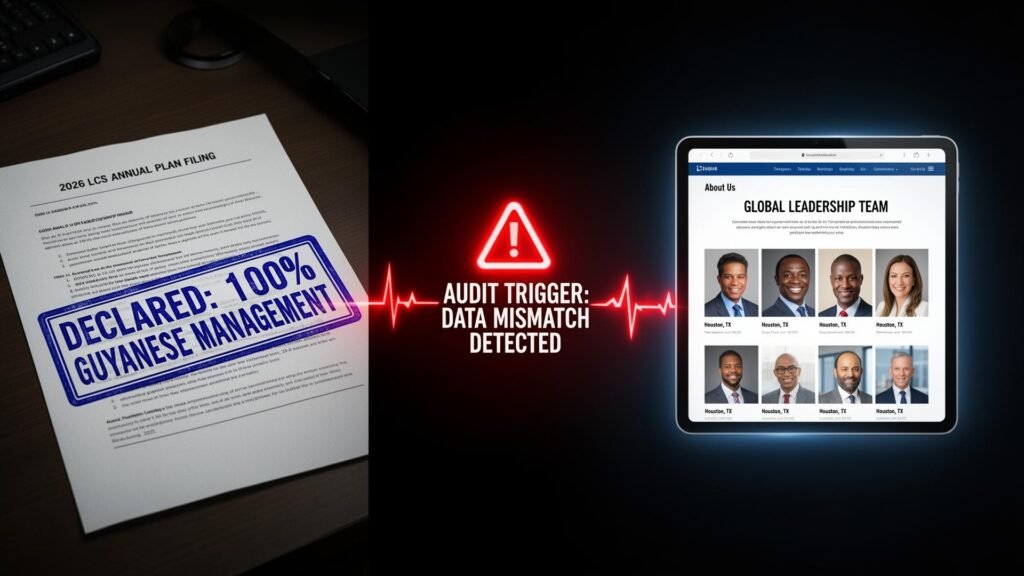
If your LCS filing claims you are a “100% Guyanese Transport Firm” (First Schedule, Sector 27), but your website lists a Miami phone number and “Global Headquarters in Houston,” you have created a documented discrepancy.
The Consequence
This digital mismatch acts as probable cause for the Secretariat to suspend your Certificate of Compliance pending a forensic audit of your payroll and board minutes.
3. The Official “First Schedule” Digital Checklist
The Local Content Act is extremely specific. It carves out 40 dedicated sectors for Guyanese nationals.
The Audit Rule
Your website’s “Services” page must use the exact legal terminology found in the First Schedule. If you use generic marketing fluff (e.g., calling yourself a “Logistics Wizard” instead of “Customs Brokerage”), automated procurement bots used by Exxon and Hess may reject your vendor application for non-compliance.
Does your website currently list these exact service categories?
4. The Protocol: Digital Sovereignty Alignment
To ensure your digital assets protect rather than endanger your Local Content Certificate, immediate alignment is required:
1. Geographic Prioritization
Your footer must explicitly label the Guyana office as “Operations HQ.” Foreign offices should be labeled “Global Technical Support” or “International Liaison,” ensuring the hierarchy places Georgetown at the top.
2. Keyword Synchronization
Review your Service pages against the checklist above. Ensure your H2 headers match the exact sector definitions.
3. Executive Visibility
Publish professional bios of your Guyanese leadership team. This publicly corroborates the data submitted in your Annual Plan, proving “Substantive Presence.”
5. Conclusion
In the 2026 audit cycle, your website is not a brochure; it is evidence. A mismatch between your legal reality and your digital reality is a liability you cannot afford.
Action Item: Conduct a “Digital vs. Legal” gap analysis before submitting your 2026 Annual Plan.
- Reference: Ministry of Natural Resources – Local Content Documents
- Reference: Parliament of Guyana – Act No. 18 of 2021
Stop chasing clients, let them chase you.
We’ll build a site that books meetings while you sleep.