

You successfully registered in the portal. You have your Vendor ID. But tenders are happening right now and you aren’t showing up in search results. You check your email every day for an Invitation to Tender (ITT). Nothing.
Here’s how to fix the Taxonomy Mismatch.
You assume there are no tenders. You are wrong. Tenders are happening right now. You just are not showing up in the search results.
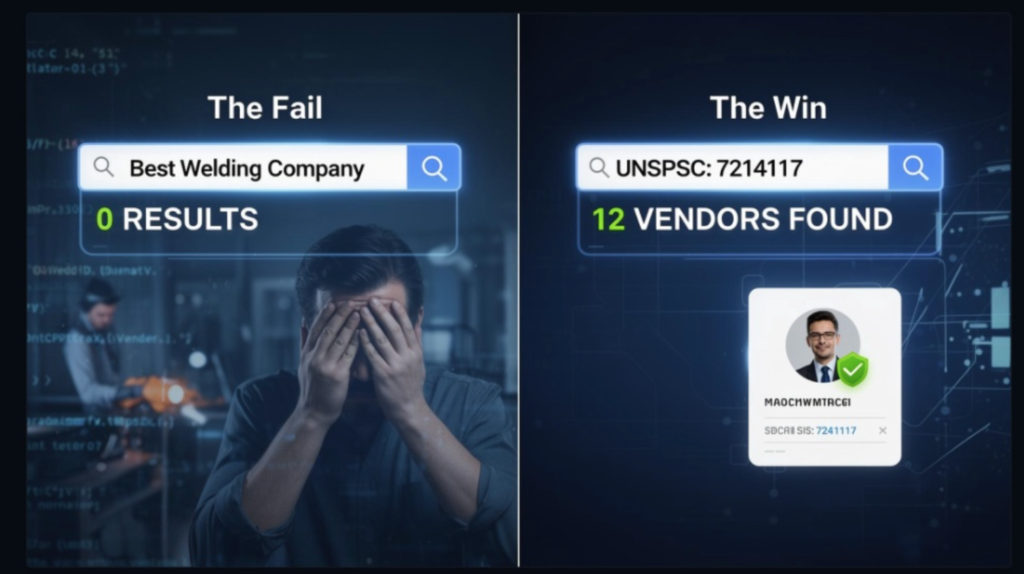
The biggest misconception in the Guyana supply chain is that human beings browse vendor lists. They do not. Procurement Officers at Tier-1 primes (Exxon, Halliburton, SBM) manage thousands of suppliers. When they need “Hazardous Waste Transport,” they do not type words into the search bar. They type UNSPSC Codes.
If your digital profile is tagged as “General Logistics” but they are querying “Code 76121500” (Refuse Disposal), you are mathematically invisible. You are speaking English; the algorithm is speaking Taxonomy.
Here is how to fix the Taxonomy Mismatch that is keeping you on the bench.
The “Procurement SEO” Reality
The United Nations Standard Products and Services Code (UNSPSC) is the global language of the Oil & Gas supply chain. Every SAP Ariba and Coupa system is built on this 8-digit backbone.
The Mismatch Scenario
You: Your website and vendor profile say: “We do welding and fabrication.”
The Buyer: Needs a high-pressure pipe welder. They filter the database for UNSPSC 72141117 (Pipeline welding service).
The Result: Your profile returns “No Match.” The invitation goes to your competitor who listed the code.
You are not being rejected. You are being omitted.
The “Code-First” Digital Strategy
To move from “Registered” to “Invited,” you must map your services to the codes they are actually searching for.
Step 1: Audit Your “Digital Metadata”
Your website is the primary source of truth for “Vendor Enrichment” bots. If your “Services” page is vague, the bot auto-classifies you as “General/Other” (The graveyard of vendors).
Action: Stop using marketing fluff (“World Class Solutions”). Start using Procurement Descriptors (“Structural Steel Erection – UNSPSC 72141000”).
Step 2: The “Cheat Sheet” for Guyana
We have analyzed the most frequent tender queries in the Stabroek Block. Is your website optimized for these?
- Logistics: Do not just say “Trucking.” Use 78101800 (Road Cargo Transport).
- Catering: Do not just say “Food.” Use 90101600 (Banquet and Catering Services).
- Security: Do not just say “Guards.” Use 92121504 (Security Guard Services).
Step 3: The “Schema” Injection
At Website.gy, we do not just write these codes on the screen. We inject them into your website’s HTML Schema.
Why? When the Ariba crawler indexes your site to update your profile, it reads the hidden metadata tags.
The Result: Your vendor profile is auto-updated with the specific codes, ensuring you pop up in the exact search results for the contracts you want.

The “Spec-Sheet” Advantage
Tier-1 Primes are currently “cleaning” their Master Vendor Lists. They are purging vendors with vague descriptions to reduce risk. By explicitly listing your UNSPSC Capabilities on your website, you signal two things:
Precision: You know exactly what you sell.
Sophistication: You understand their internal systems.
Stop playing hide and seek with a Billion-dollar buyer. Translate your business into their language.
Stop chasing clients, let them chase you.
We’ll build a site that books meetings while you sleep.